




About
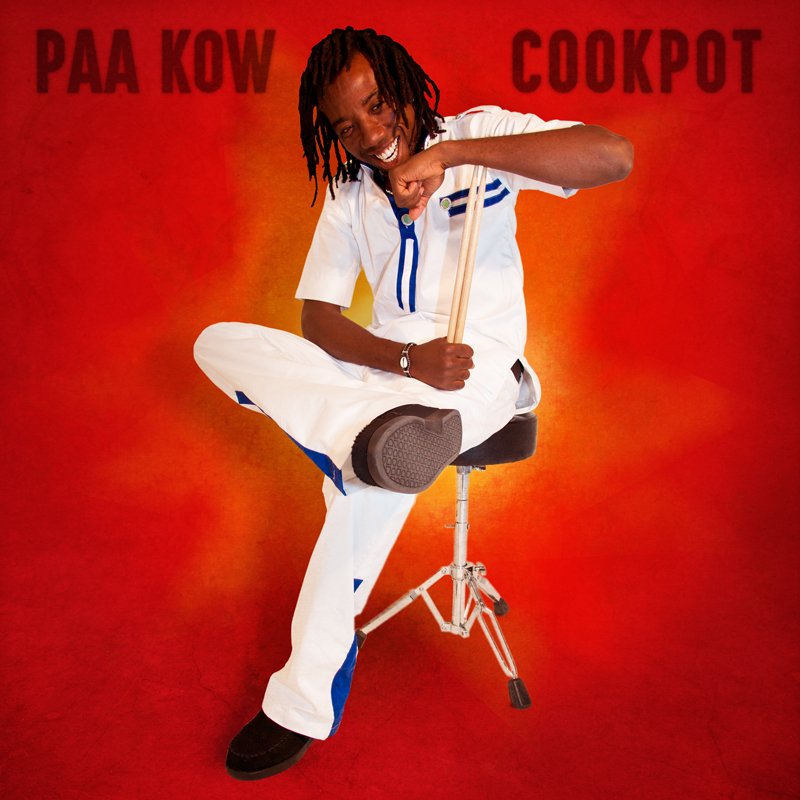
Having toured internationally, sharing stages with both African and American luminaries including Kojo Antwi, Amakye Dede and Victor Wooten, Ghana born drummer and composer, Paa Kow, (pronounced Pah-Ko), blends rhythm and artistry from his home with jazz and African roots creating his own Afro-Fusion sound. Dubbed "Ghana's most artistic drummer" (Modern Ghana), he plays ...
Contact
Current News
- 05/15/201907/02/2019
- New York, NY
Today’s Special: Paa Kow and his Afro-fusion Orchestra Bring High-Energy Drum-Powered Highlife, Funk, and Jazz to Rochester and Beyond
Ghanaian-born, U.S.-based drummer Paa Kow speaks a dozen musical languages, from the deep rhythmic traditions of his native Ghana to the patois perfected by the likes of George Clinton and George Benson. “My music isn’t traditional, but it has deep roots. I want to invent my own international style,” he explains. “The highlife music is there, but when you listen, it’s kind of jazz, too. It’s funk. It’s the way the music comes to me.”
Whatever...
- WGBO.org, Event preview, 07/02/2019, Paa Kow Tour 2019 Text
- pix11, Event preview, 07/02/2019, Paa Kow Tour 2019 Text
- Stepout Buffalo, Event preview, 06/18/2019, Paa Kow W/ Special Guests Text
- Visit Buffalo Niagara, Event preview, 06/18/2019, Paa Kow Text
- + Show More
News
Ghanaian-born, U.S.-based drummer Paa Kow speaks a dozen musical languages, from the deep rhythmic traditions of his native Ghana to the patois perfected by the likes of George Clinton and George Benson. “My music isn’t traditional, but it has deep roots. I want to invent my own international style,” he explains. “The highlife music is there, but when you listen, it’s kind of jazz, too. It’s funk. It’s the way the music comes to me.”
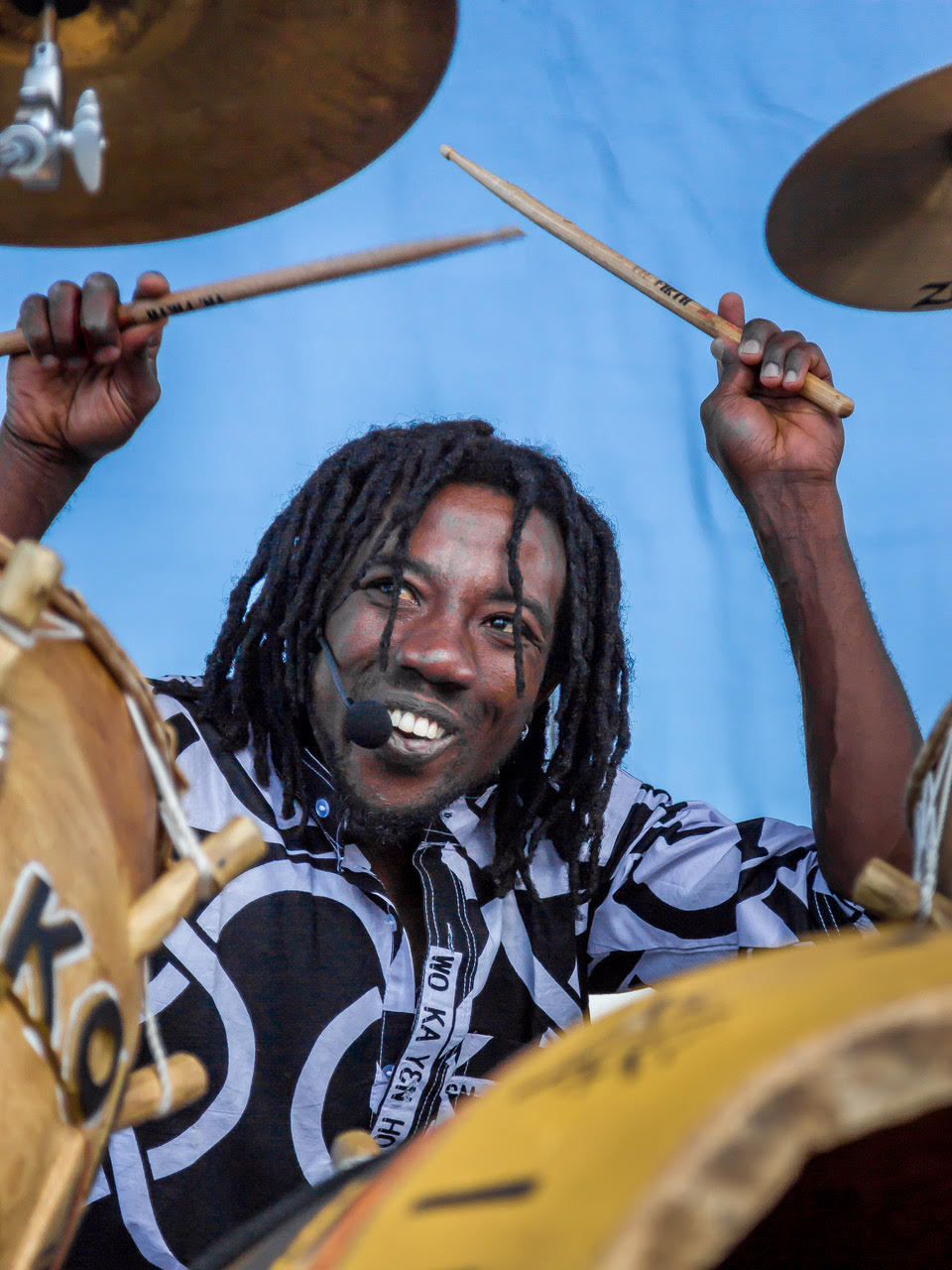
Whatever the style, Paa Kow’s live set hits the sweet spot between addictive groove and delectable complexity. Lines shift and lock, all entwined with Paa Kow’s effortless precision.
When Paa Kow and his Afro-fusion Orchestra take to the stage at the Rochester International Jazz Festival, the Green Mill in Chicago, or listening rooms around the U.S.A., they cook up a set for the moment (U.S. Tour, Summer 2019). “I like to call songs on stage, I feel the crowd and I call the song, so every night is different!” Expect to hear grooves drawn from all of Paa Kow’s three albums to date (Cookpot, 2017; Ask, 2014; Hand Go, Hand Come, 2012).
“I feel like music is all about the ingredients. You have different backgrounds, someone from the US, from Europe, from Africa,” muses Paa Kow. “Then the pot part, that’s the container, the way the groove set. It’s like something’s boiling on the fire. When we play together, we bring all these different energies and inspirations together.” It’s been a couple of years since his album Cookpot caught fire, but the music is only getting tastier. “Today, my music has a today vibe, tomorrow it will be different. The songs change, but it will still feel like me. Stew tastes better the longer it cooks!” Paa Kow is already at work on the next course: look for his new album, recorded in the U.S.A. and Ghana, in 2020.
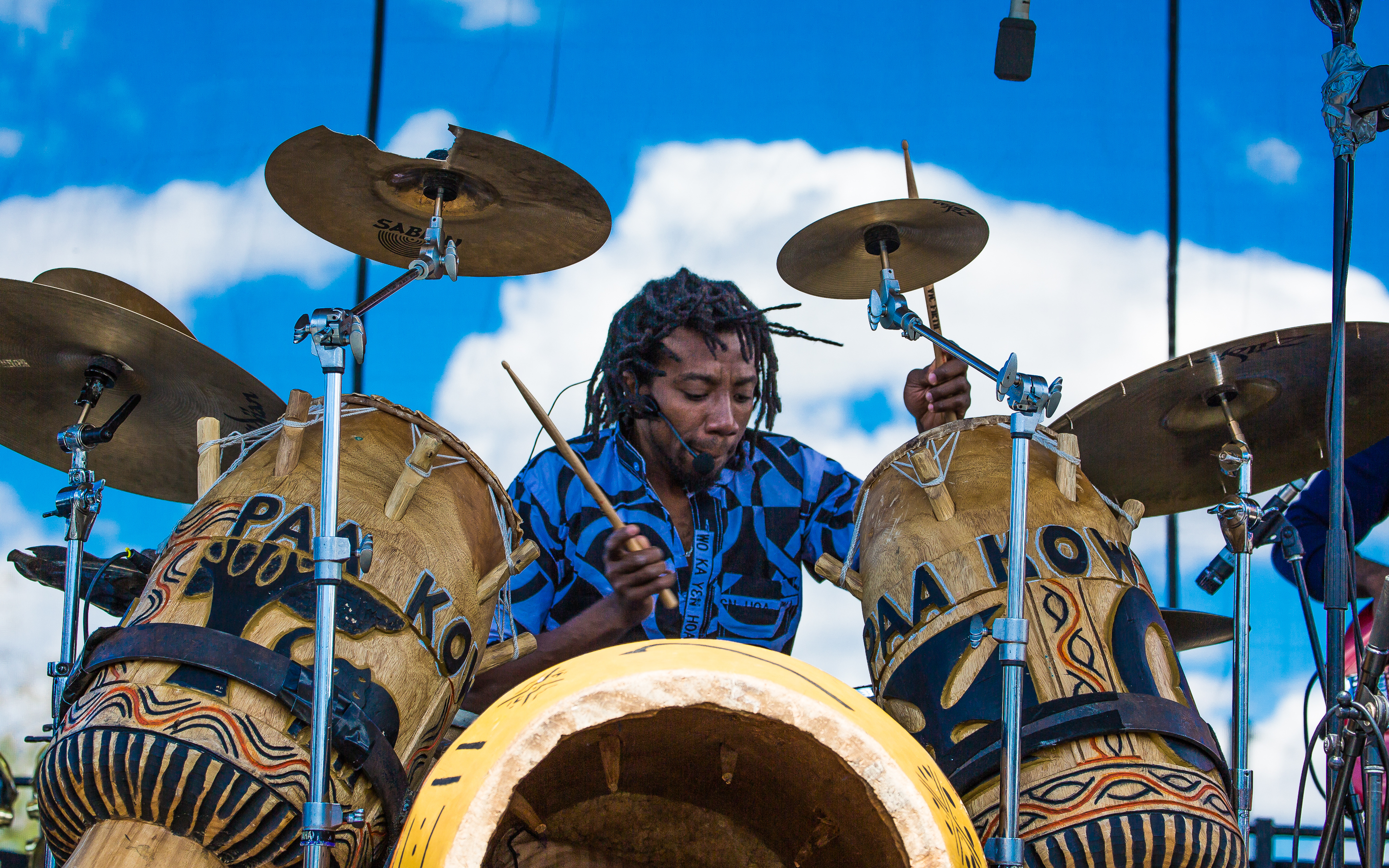
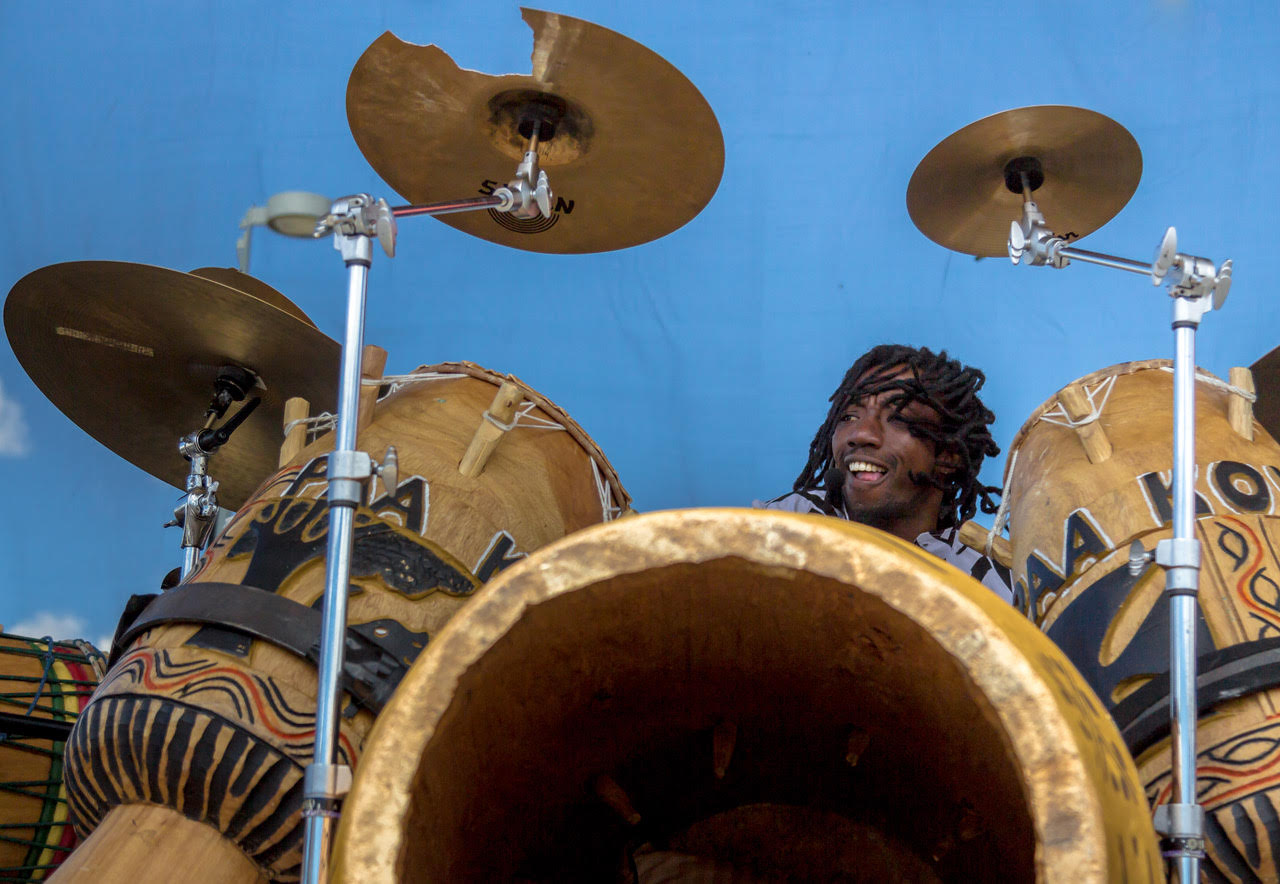
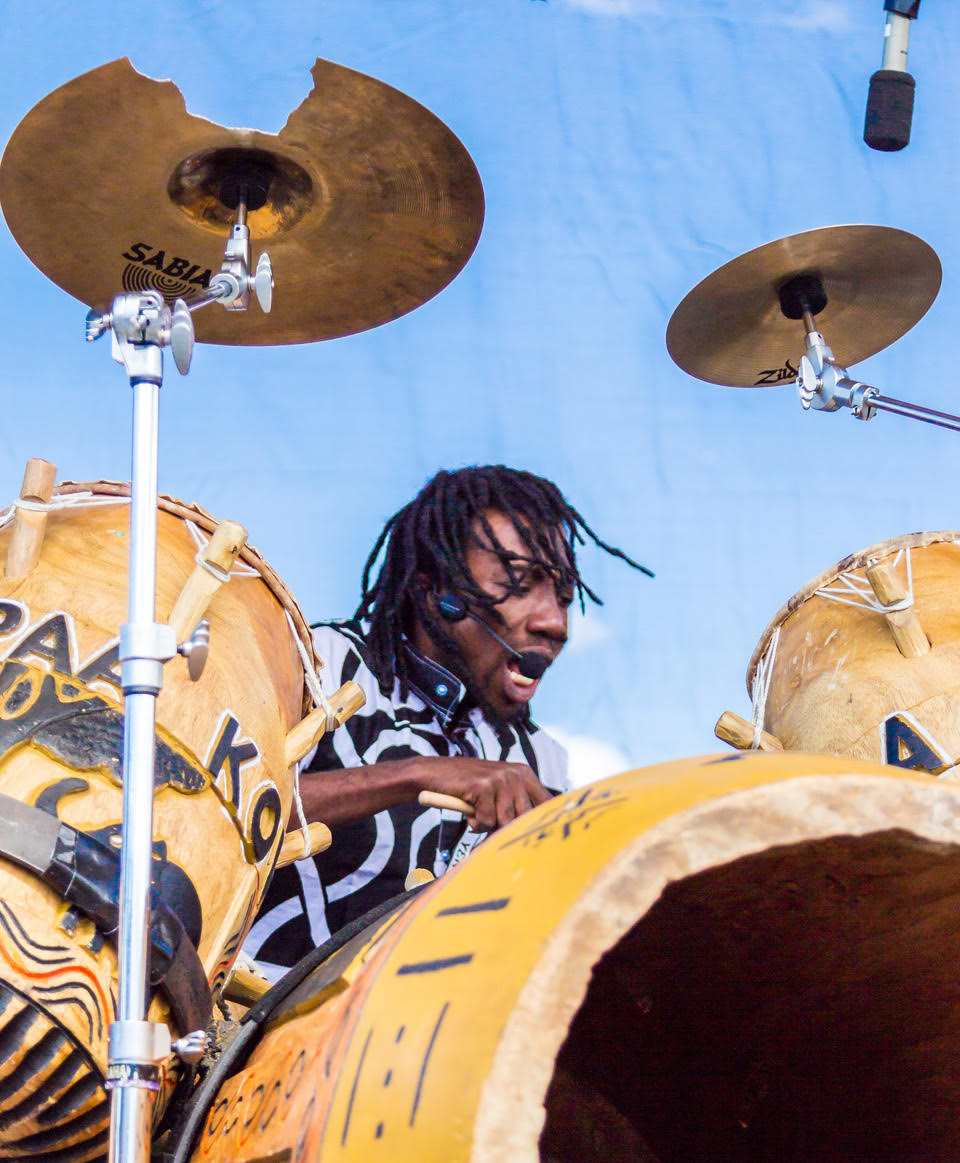
Paa Kow’s international sound is rooted in his native Ghana, quite literally: his unique drum set is made from the trunks of trees. Paa Kow went to a drum maker to create with a clear idea of what he wanted. “We talked a lot about it. It was hard to find a bass drum that big. The makers told me ‘We don’t think we can get this for you,’” Paa Kow recalls. “One day, I woke up and they told me they had found a tree. The bass drum is made from a single tree. It gives me a really nice sound that I love.” Sabian cymbals (thanks to an endorsement from the venerable maker) are a recent addition to the set, and a sign of how Paa Kow is growing beyond his roots.
Paa Kow was used to crafting his own kit, something he did obsessively as a small boy, using whatever he had on hand, old buckets, cans, sandals, anything. From a musical family, he grew up living and breathing music, to the point he would stow away in a bass drum in hopes of getting to gig with his relatives instead of going to school. With time, he became a regional whizkid, eventually landing in Accra and gaining a reputation for astounding playing, despite his youth.
Where he’s going requires fellow travelers, ones passionate about learning all they can about Paa Kow’s musical worlds. “I believe that music is a language. But it’s not universal, you have to learn it. You learn, oh, you don’t say that in our language. It’s a conversation. You don’t have to be from Ghana, say to learn my language,” notes Paa Kow. “When the musical skills are there, I have been able to get musicians from everywhere to speak the same language I speak. They love what I do, and what they do. That’s what brings my Afro-Fusion Orchestra together.”
Feats of translation and communication like this are what set apart truly international artists like Salif Keita, Richard Bona, and Fela Kuti, and Paa Kow has set his sights on finding that same balance of deep rootedness, unique style, and international relevance. Dedication to music “is like breathing,” adds Paa Kow. “I didn’t go to music school to start playing. The more I learn, the more it comes to me. I love every minute of it.”
Ghanaian-born, U.S.-based drummer Paa Kow speaks a dozen musical languages, from the deep rhythmic traditions of his native Ghana to the patois perfected by the likes of George Clinton and George Benson. “My music isn’t traditional, but it has deep roots. I want to invent my own international style,” he explains. “The highlife music is there, but when you listen, it’s kind of jazz, too. It’s funk. It’s the way the music comes to me.”
Whatever the style, Paa Kow’s live set hits the sweet spot between addictive groove and delectable complexity. Lines shift and lock, all entwined with Paa Kow’s effortless precision.
When Paa Kow and his Afro-fusion Orchestra take to the stage at the Rochester International Jazz Festival, the Green Mill in Chicago, or listening rooms around the U.S.A., they cook up a set for the moment (U.S. Tour, Summer 2019). “I like to call songs on stage, I feel the crowd and I call the song, so every night is different!” Expect to hear grooves drawn from all of Paa Kow’s three albums to date (Cookpot, 2017; Ask, 2014; Hand Go, Hand Come, 2012).
“I feel like music is all about the ingredients. You have different backgrounds, someone from the US, from Europe, from Africa,” muses Paa Kow. “Then the pot part, that’s the container, the way the groove set. It’s like something’s boiling on the fire. When we play together, we bring all these different energies and inspirations together.” It’s been a couple of years since his album Cookpot caught fire, but the music is only getting tastier. “Today, my music has a today vibe, tomorrow it will be different. The songs change, but it will still feel like me. Stew tastes better the longer it cooks!” Paa Kow is already at work on the next course: look for his new album, recorded in the U.S.A. and Ghana, in 2020.
Paa Kow’s international sound is rooted in his native Ghana, quite literally: his unique drum set is made from the trunks of trees. Paa Kow went to a drum maker to create with a clear idea of what he wanted. “We talked a lot about it. It was hard to find a bass drum that big. The makers told me ‘We don’t think we can get this for you,’” Paa Kow recalls. “One day, I woke up and they told me they had found a tree. The bass drum is made from a single tree. It gives me a really nice sound that I love.” Sabian cymbals (thanks to an endorsement from the venerable maker) are a recent addition to the set, and a sign of how Paa Kow is growing beyond his roots.
Paa Kow was used to crafting his own kit, something he did obsessively as a small boy, using whatever he had on hand, old buckets, cans, sandals, anything. From a musical family, he grew up living and breathing music, to the point he would stow away in a bass drum in hopes of getting to gig with his relatives instead of going to school. With time, he became a regional whizkid, eventually landing in Accra and gaining a reputation for astounding playing, despite his youth.
Where he’s going requires fellow travelers, ones passionate about learning all they can about Paa Kow’s musical worlds. “I believe that music is a language. But it’s not universal, you have to learn it. You learn, oh, you don’t say that in our language. It’s a conversation. You don’t have to be from Ghana, say to learn my language,” notes Paa Kow. “When the musical skills are there, I have been able to get musicians from everywhere to speak the same language I speak. They love what I do, and what they do. That’s what brings my Afro-Fusion Orchestra together.”
Feats of translation and communication like this are what set apart truly international artists like Salif Keita, Richard Bona, and Fela Kuti, and Paa Kow has set his sights on finding that same balance of deep rootedness, unique style, and international relevance. Dedication to music “is like breathing,” adds Paa Kow. “I didn’t go to music school to start playing. The more I learn, the more it comes to me. I love every minute of it.”
Ghanaian-born, U.S.-based drummer Paa Kow speaks a dozen musical languages, from the deep rhythmic traditions of his native Ghana to the patois perfected by the likes of George Clinton and George Benson. “My music isn’t traditional, but it has deep roots. I want to invent my own international style,” he explains. “The highlife music is there, but when you listen, it’s kind of jazz, too. It’s funk. It’s the way the music comes to me.”
Whatever the style, Paa Kow’s live set hits the sweet spot between addictive groove and delectable complexity. Lines shift and lock, all entwined with Paa Kow’s effortless precision.
When Paa Kow and his Afro-fusion Orchestra take to the stage at the Rochester International Jazz Festival, the Green Mill in Chicago, or listening rooms around the U.S.A., they cook up a set for the moment (U.S. Tour, Summer 2019). “I like to call songs on stage, I feel the crowd and I call the song, so every night is different!” Expect to hear grooves drawn from all of Paa Kow’s three albums to date (Cookpot, 2017; Ask, 2014; Hand Go, Hand Come, 2012).
“I feel like music is all about the ingredients. You have different backgrounds, someone from the US, from Europe, from Africa,” muses Paa Kow. “Then the pot part, that’s the container, the way the groove set. It’s like something’s boiling on the fire. When we play together, we bring all these different energies and inspirations together.” It’s been a couple of years since his album Cookpot caught fire, but the music is only getting tastier. “Today, my music has a today vibe, tomorrow it will be different. The songs change, but it will still feel like me. Stew tastes better the longer it cooks!” Paa Kow is already at work on the next course: look for his new album, recorded in the U.S.A. and Ghana, in 2020.
Paa Kow’s international sound is rooted in his native Ghana, quite literally: his unique drum set is made from the trunks of trees. Paa Kow went to a drum maker to create with a clear idea of what he wanted. “We talked a lot about it. It was hard to find a bass drum that big. The makers told me ‘We don’t think we can get this for you,’” Paa Kow recalls. “One day, I woke up and they told me they had found a tree. The bass drum is made from a single tree. It gives me a really nice sound that I love.” Sabian cymbals (thanks to an endorsement from the venerable maker) are a recent addition to the set, and a sign of how Paa Kow is growing beyond his roots.
Paa Kow was used to crafting his own kit, something he did obsessively as a small boy, using whatever he had on hand, old buckets, cans, sandals, anything. From a musical family, he grew up living and breathing music, to the point he would stow away in a bass drum in hopes of getting to gig with his relatives instead of going to school. With time, he became a regional whizkid, eventually landing in Accra and gaining a reputation for astounding playing, despite his youth.
Where he’s going requires fellow travelers, ones passionate about learning all they can about Paa Kow’s musical worlds. “I believe that music is a language. But it’s not universal, you have to learn it. You learn, oh, you don’t say that in our language. It’s a conversation. You don’t have to be from Ghana, say to learn my language,” notes Paa Kow. “When the musical skills are there, I have been able to get musicians from everywhere to speak the same language I speak. They love what I do, and what they do. That’s what brings my Afro-Fusion Orchestra together.”
Feats of translation and communication like this are what set apart truly international artists like Salif Keita, Richard Bona, and Fela Kuti, and Paa Kow has set his sights on finding that same balance of deep rootedness, unique style, and international relevance. Dedication to music “is like breathing,” adds Paa Kow. “I didn’t go to music school to start playing. The more I learn, the more it comes to me. I love every minute of it.”
Ghanaian-born, U.S.-based drummer Paa Kow speaks a dozen musical languages, from the deep rhythmic traditions of his native Ghana to the patois perfected by the likes of George Clinton and George Benson. “My music isn’t traditional, but it has deep roots. I want to invent my own international style,” he explains. “The highlife music is there, but when you listen, it’s kind of jazz, too. It’s funk. It’s the way the music comes to me.”
Whatever the style, Paa Kow’s live set hits the sweet spot between addictive groove and delectable complexity. Lines shift and lock, all entwined with Paa Kow’s effortless precision.
When Paa Kow and his Afro-fusion Orchestra take to the stage at the Rochester International Jazz Festival, the Green Mill in Chicago, or listening rooms around the U.S.A., they cook up a set for the moment (U.S. Tour, Summer 2019). “I like to call songs on stage, I feel the crowd and I call the song, so every night is different!” Expect to hear grooves drawn from all of Paa Kow’s three albums to date (Cookpot, 2017; Ask, 2014; Hand Go, Hand Come, 2012).
“I feel like music is all about the ingredients. You have different backgrounds, someone from the US, from Europe, from Africa,” muses Paa Kow. “Then the pot part, that’s the container, the way the groove set. It’s like something’s boiling on the fire. When we play together, we bring all these different energies and inspirations together.” It’s been a couple of years since his album Cookpot caught fire, but the music is only getting tastier. “Today, my music has a today vibe, tomorrow it will be different. The songs change, but it will still feel like me. Stew tastes better the longer it cooks!” Paa Kow is already at work on the next course: look for his new album, recorded in the U.S.A. and Ghana, in 2020.
Paa Kow’s international sound is rooted in his native Ghana, quite literally: his unique drum set is made from the trunks of trees. Paa Kow went to a drum maker to create with a clear idea of what he wanted. “We talked a lot about it. It was hard to find a bass drum that big. The makers told me ‘We don’t think we can get this for you,’” Paa Kow recalls. “One day, I woke up and they told me they had found a tree. The bass drum is made from a single tree. It gives me a really nice sound that I love.” Sabian cymbals (thanks to an endorsement from the venerable maker) are a recent addition to the set, and a sign of how Paa Kow is growing beyond his roots.
Paa Kow was used to crafting his own kit, something he did obsessively as a small boy, using whatever he had on hand, old buckets, cans, sandals, anything. From a musical family, he grew up living and breathing music, to the point he would stow away in a bass drum in hopes of getting to gig with his relatives instead of going to school. With time, he became a regional whizkid, eventually landing in Accra and gaining a reputation for astounding playing, despite his youth.
Where he’s going requires fellow travelers, ones passionate about learning all they can about Paa Kow’s musical worlds. “I believe that music is a language. But it’s not universal, you have to learn it. You learn, oh, you don’t say that in our language. It’s a conversation. You don’t have to be from Ghana, say to learn my language,” notes Paa Kow. “When the musical skills are there, I have been able to get musicians from everywhere to speak the same language I speak. They love what I do, and what they do. That’s what brings my Afro-Fusion Orchestra together.”
Feats of translation and communication like this are what set apart truly international artists like Salif Keita, Richard Bona, and Fela Kuti, and Paa Kow has set his sights on finding that same balance of deep rootedness, unique style, and international relevance. Dedication to music “is like breathing,” adds Paa Kow. “I didn’t go to music school to start playing. The more I learn, the more it comes to me. I love every minute of it.”
Ghanaian-born, U.S.-based drummer Paa Kow speaks a dozen musical languages, from the deep rhythmic traditions of his native Ghana to the patois perfected by the likes of George Clinton and George Benson. “My music isn’t traditional, but it has deep roots. I want to invent my own international style,” he explains. “The highlife music is there, but when you listen, it’s kind of jazz, too. It’s funk. It’s the way the music comes to me.”
Whatever the style, Paa Kow’s live set hits the sweet spot between addictive groove and delectable complexity. Lines shift and lock, all entwined with Paa Kow’s effortless precision.
When Paa Kow and his Afro-fusion Orchestra take to the stage at the Rochester International Jazz Festival, the Green Mill in Chicago, or listening rooms around the U.S.A., they cook up a set for the moment (U.S. Tour, Summer 2019). “I like to call songs on stage, I feel the crowd and I call the song, so every night is different!” Expect to hear grooves drawn from all of Paa Kow’s three albums to date (Cookpot, 2017; Ask, 2014; Hand Go, Hand Come, 2012).
“I feel like music is all about the ingredients. You have different backgrounds, someone from the US, from Europe, from Africa,” muses Paa Kow. “Then the pot part, that’s the container, the way the groove set. It’s like something’s boiling on the fire. When we play together, we bring all these different energies and inspirations together.” It’s been a couple of years since his album Cookpot caught fire, but the music is only getting tastier. “Today, my music has a today vibe, tomorrow it will be different. The songs change, but it will still feel like me. Stew tastes better the longer it cooks!” Paa Kow is already at work on the next course: look for his new album, recorded in the U.S.A. and Ghana, in 2020.
Paa Kow’s international sound is rooted in his native Ghana, quite literally: his unique drum set is made from the trunks of trees. Paa Kow went to a drum maker to create with a clear idea of what he wanted. “We talked a lot about it. It was hard to find a bass drum that big. The makers told me ‘We don’t think we can get this for you,’” Paa Kow recalls. “One day, I woke up and they told me they had found a tree. The bass drum is made from a single tree. It gives me a really nice sound that I love.” Sabian cymbals (thanks to an endorsement from the venerable maker) are a recent addition to the set, and a sign of how Paa Kow is growing beyond his roots.
Paa Kow was used to crafting his own kit, something he did obsessively as a small boy, using whatever he had on hand, old buckets, cans, sandals, anything. From a musical family, he grew up living and breathing music, to the point he would stow away in a bass drum in hopes of getting to gig with his relatives instead of going to school. With time, he became a regional whizkid, eventually landing in Accra and gaining a reputation for astounding playing, despite his youth.
Where he’s going requires fellow travelers, ones passionate about learning all they can about Paa Kow’s musical worlds. “I believe that music is a language. But it’s not universal, you have to learn it. You learn, oh, you don’t say that in our language. It’s a conversation. You don’t have to be from Ghana, say to learn my language,” notes Paa Kow. “When the musical skills are there, I have been able to get musicians from everywhere to speak the same language I speak. They love what I do, and what they do. That’s what brings my Afro-Fusion Orchestra together.”
Feats of translation and communication like this are what set apart truly international artists like Salif Keita, Richard Bona, and Fela Kuti, and Paa Kow has set his sights on finding that same balance of deep rootedness, unique style, and international relevance. Dedication to music “is like breathing,” adds Paa Kow. “I didn’t go to music school to start playing. The more I learn, the more it comes to me. I love every minute of it.”